




How Many Boxes Do I Need to Move?
 Lifestyle Moving & Storage
Most people underestimate this by about a third, then make an emergency run to a hardware store on the night before the move and pay four dollars a box for the privilege.
The short answer: a studio usually needs 20 to 30 boxes, a one-bedroom needs 30 to 50, a two-bedroom needs 50 to 75, and a three-bedroom needs 75 to 110. Those ranges assume an average amount of stuff and standard New York apartment square footage.
That gets you close. Below is how to turn that estimate into an actual number, which sizes to buy in which proportion, and why the answer changes if you live in a fifth-floor walk-up.
How Many Boxes by Apartment Size
Start here, then adjust.
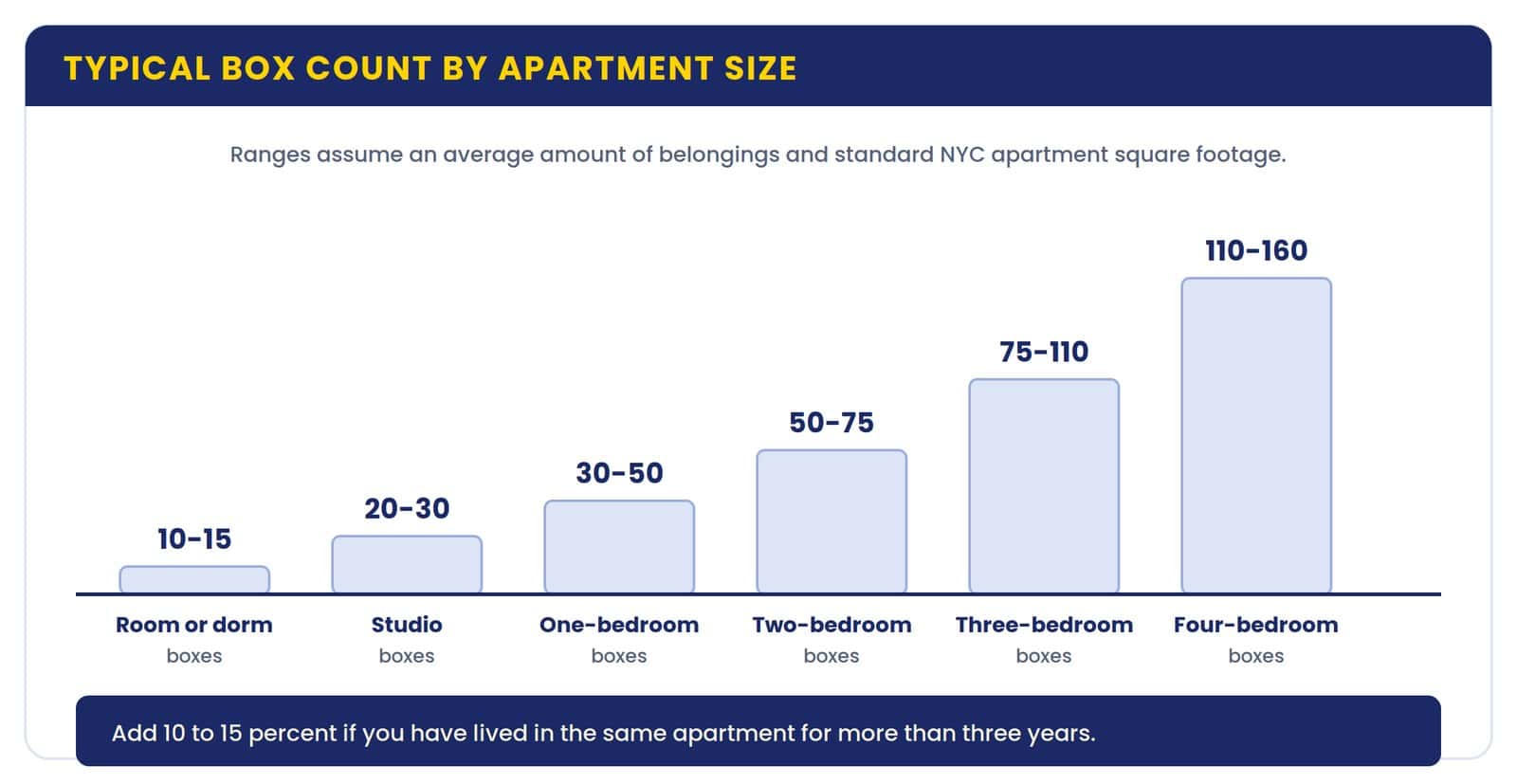
A few things shift these numbers more than square footage does:
How long you have lived there. Time in one apartment is the single biggest variable. Someone two years into a one-bedroom often lands at the bottom of the range. Someone eight years into the same apartment lands at the top, or above it. Add roughly 10 to 15 percent for every few years past the three-year mark.
Whether you cook. A serious home kitchen can add 10 to 15 boxes on its own, most of them dish packs. A kitchen used mainly for coffee and takeout might need six.
Books, records and hobbies. These are the categories that blow up estimates. A wall of books is 15 to 25 small boxes by itself. Records are heavier still.
Closet volume. New York closets are small, but that does not mean the wardrobe is. If clothes are stored under beds, in garment racks, or in a second closet at a parent’s place, count them.
What the movers will handle loose. Furniture, mattresses, rugs, floor lamps and large art do not go in boxes. Nothing in these counts covers those items.
Which Box Sizes to Buy, and in What Proportion
Buying the right total in the wrong sizes causes almost as much trouble as buying too few. The most common mistake is buying too many large boxes, filling them with books, and then being unable to lift them.
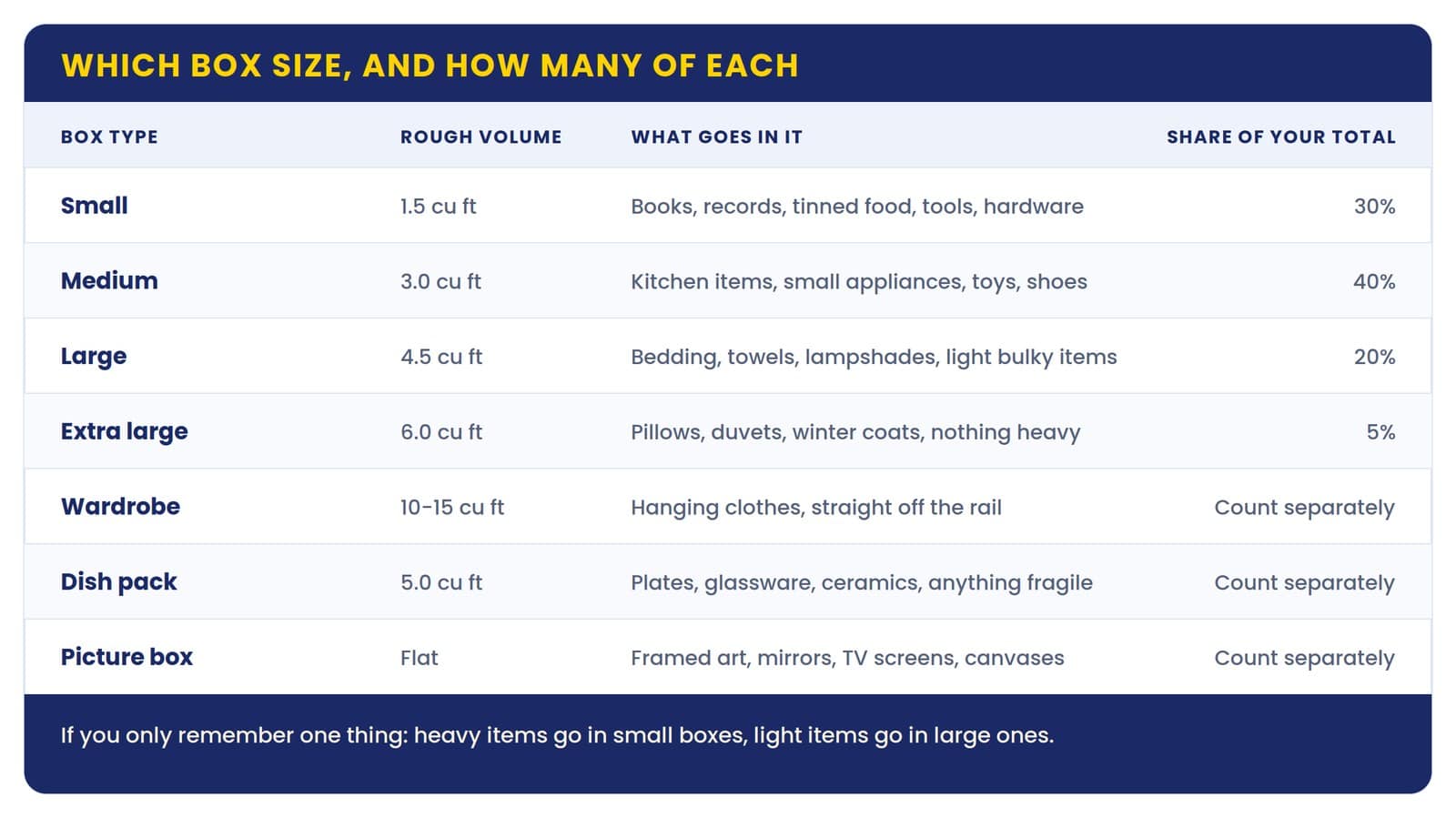
A reliable split for a typical apartment is roughly 30 percent small, 40 percent medium, 20 percent large and 5 percent extra large, with wardrobe boxes, dish packs and picture boxes counted separately on top of that.
The principle behind the split is simple: weight should determine box size, not volume. A small box full of books weighs about as much as a large box full of bedding. If every box in the apartment weighs roughly the same, the packing was done correctly.
Wardrobe boxes deserve a specific note. They feel like an indulgence until moving day, when hanging clothes go straight from the rail into the box and straight back onto a rail at the other end. For a full closet, two or three wardrobe boxes will save an hour of folding and an hour of ironing. Most movers rent them rather than sell them.
How Many Boxes Per Room
If you want a number closer than a range, count by room instead of by apartment. Walk through each room, use the table below, and add the results.
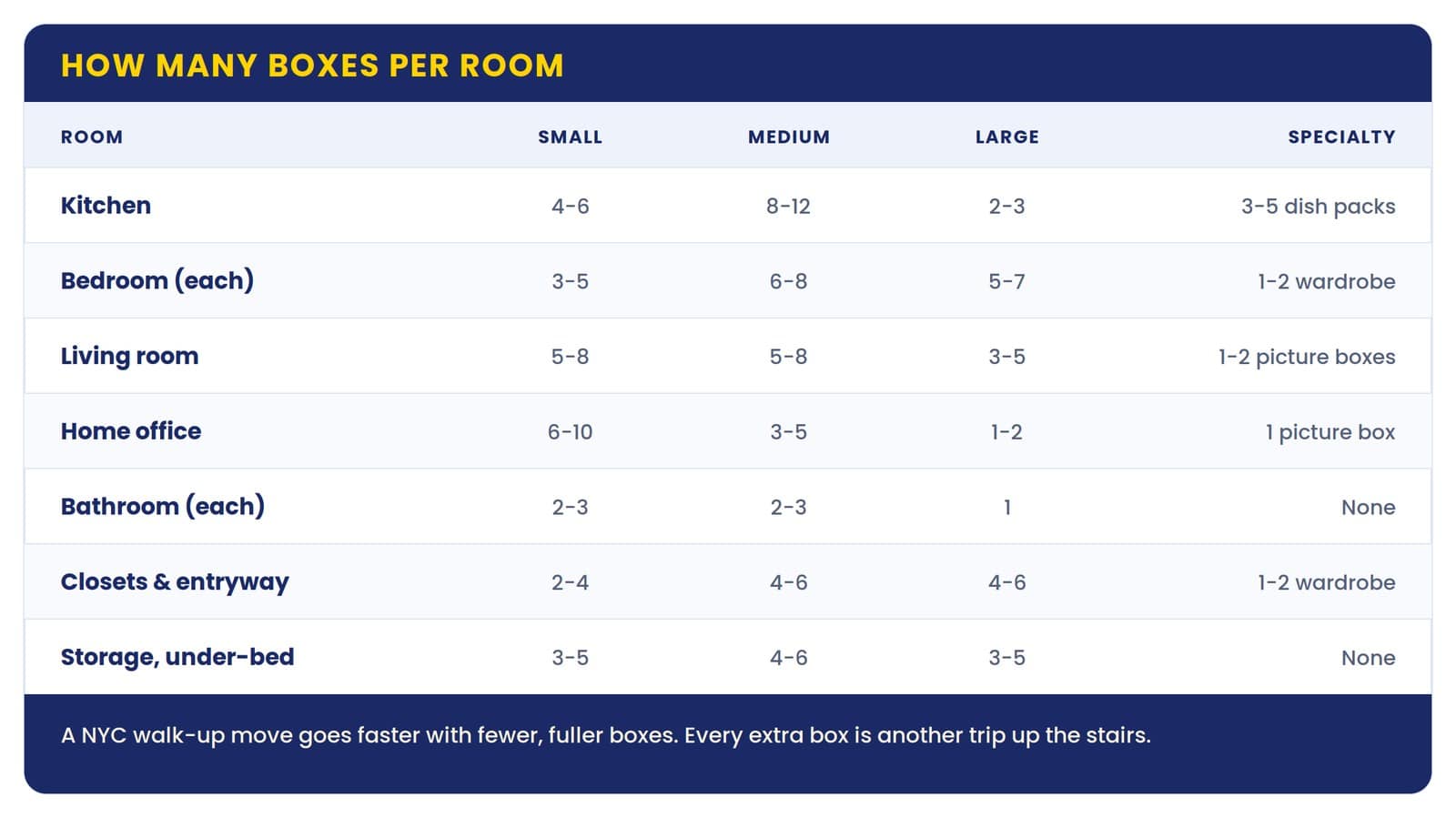
Kitchens consistently need the most boxes and the most protective material. Bathrooms consistently need the fewest, and half of what is in them should be thrown out rather than moved.
Home offices are the room people most often underestimate. Paperwork, cables, monitors, books and equipment add up fast, and most of it belongs in small boxes because of the weight.
A Faster Way to Estimate: Count Your Shelves
If walking room to room feels like too much, there is a shortcut that works surprisingly well.
Count every shelf, drawer and cabinet in the apartment. Then assume:
- One bookshelf shelf fills roughly one small box
- One dresser drawer fills roughly one medium box
- One kitchen cabinet fills roughly one to two mediums, plus a dish pack for the fragile cabinet
- One closet shelf fills roughly one large box
- One linear foot of hanging clothes is roughly a quarter of a wardrobe box
Add it up and compare the result against the apartment-size range above. If the two numbers are close, buy that quantity. If the shelf count is significantly higher, trust the shelf count.
Why NYC Changes the Answer
Most box-count guides are written for houses in places where a truck parks in a driveway and the front door is ten feet away. Three New York realities change the calculation.
Walk-ups reward fewer, fuller boxes. Every box is a separate trip up the stairs, and movers price by time. Two hundred half-full boxes cost more to carry up four flights than 120 properly packed ones. Pack to the top of every box, and use the weight rule to keep them liftable.
Elevator buildings reward uniform boxes. If the freight elevator is reserved for a two-hour window, boxes that stack cleanly on a dolly move far faster than a mixed pile of odd sizes and reused liquor-store cartons. Uniform sizes are worth paying for.
Storage changes what “enough” means. If part of the load is going into storage rather than into the new apartment, that portion needs sturdier boxes and clearer labelling, because it may sit for months and be opened by someone who did not pack it. Anything going into storage should be double-taped and labelled on two sides.
There is also a scheduling point worth making. Boxes are easy to get in February and hard to get on the last weekend in June, when half of the city’s leases turn over at once. If moving in peak season, order supplies two to three weeks ahead rather than a few days ahead.
How Many Boxes Should You Buy Versus Estimate?
Buy about 10 percent more than the estimate, and buy them from a source that takes returns on unused, unopened boxes. Almost every supplier and most moving companies will.
Running out mid-pack is far more expensive than over-ordering. It stops the packing entirely, usually late at night, and the replacement boxes get bought at retail prices in a rush.
The other reason to over-order slightly: the last 10 percent of any move is the awkward part. The junk drawer, the cleaning cupboard, the cables, the things that were behind the couch. That material always needs more boxes than anyone plans for.
Five Mistakes That Wreck a Box Estimate
Counting rooms instead of contents. A one-bedroom occupied by a minimalist and a one-bedroom occupied by a collector are the same apartment and completely different moves.
Using free supermarket boxes for everything. They are free for a reason. They are not uniform, they do not stack, they have often been damp, and they collapse when stacked in a truck. They are fine for linens and terrible for anything else.
Buying only large boxes. Large boxes filled with heavy items are the number one cause of split cartons and strained backs on moving day.
Forgetting the specialty boxes. Dish packs, wardrobe boxes and picture boxes are not covered by the general count, and every apartment needs some of each.
Packing before decluttering. Every box packed with something that will be thrown away in the new apartment costs money to buy, time to pack, and money to carry. Sort first, then count. If a serious sort is part of the plan, downsizing before a move is worth reading first.
When Not to Buy Boxes at All
For some moves, buying boxes is the wrong question.
If the timeline is short, if the apartment is a walk-up, or if the kitchen and the art are the difficult parts, professional packing services usually include the materials. The crew arrives with the right sizes in the right quantities and takes the leftovers away. For a full apartment, this often costs less than the combined price of buying supplies, taking days off work, and repacking whatever was packed badly.
Partial packing is also an option that people rarely ask about. Having a crew handle only the kitchen and the fragile items, while you handle clothes and books yourself, covers the two categories where damage actually happens.
Need Help With Packing and Moving Boxes?
Working out your own number and still not sure? Take a look at our packing services and moving box options — we deliver supplies across the five boroughs and can handle as much or as little of the packing as you want.

EXPERT NYC MOVERS & STORAGE SOLUTIONS
Looking for the best place to get moving and storage solutions in NYC? Look no further than Lifestyle Moving & storage! We are the leading provider of moving and storage solutions in NYC, and we’re here to help make your move as pleasant as possible.
We are fully licensed and insured and offer a wide range of services to meet your moving and storage needs. We are a one-stop shop for moving and storage. Contact us today.
