




How to Move a Mattress
 Lifestyle Moving & Storage

To move a mattress, seal it in a mattress bag, carry it on edge with one person at each end, stand it on edge against the truck wall for the drive, and lay it flat as soon as it reaches the new room. Never fold or bend it unless it is memory foam. Two people, one bag, and ten minutes of planning are the difference between a clean move and a torn cover on a stairwell railing.
That is the short version. The rest of this guide covers the parts people get wrong: getting a queen around a brownstone landing, what happens when you fold an innerspring, how to transport a mattress without a truck, and what NYC requires if the old one is going to the curb.
What You Need to Move a Mattress
Gather everything before the mattress leaves the bed frame. Stopping halfway to hunt for tape is how covers get dragged across floors.

If you are packing the rest of the bedroom at the same time, it helps to have packing supplies on hand rather than buying them piece by piece.
How to Move a Mattress Step by Step
- Strip the bed completely. Sheets, mattress protector, pillows, everything. Loose bedding turns into a tripping hazard on stairs.
- Take the bed frame apart first. Bag the hardware and tape it to the headboard. A frame left standing in the room gives you nowhere to maneuver.
- Clear the path before anyone lifts anything. Doors propped open, rugs rolled up, corners of the hallway checked. Look at the tightest turn on the route and decide how the mattress will pivot through it while your hands are still empty.
- Slide the mattress into the bag. Stand it on one edge, lean it against the wall, and pull the bag down over it. Tape every seam shut. If you are also moving the box spring, bag that separately.
- Compress it with straps. Two straps, each about a third of the way in from one end, tightened just enough to firm the mattress up. This is the single biggest improvement to how a mattress carries. Do not crank the straps down on a memory foam mattress.
- Carry it on edge, not flat. Flat means a wide, floppy load that scrapes both walls. On edge, you have a narrow profile and real control. One person at each end, walking in step.
- Load it on edge in the vehicle. Stand it along the side wall of the truck and strap it in place. This keeps it stable, saves floor space, and makes it impossible to stack boxes or furniture on top of it. Lay it flat once it is in the new bedroom, not before.
Getting a Mattress Through Doorways, Stairs, and Elevators
This is where most NYC mattress moves actually go wrong. The mattress fits through the door. It is the turn after the door that causes the problem.
Walk-ups and brownstone stairwells. Lead with the mattress on edge and let the person on the low end steer. On a hard 180-degree landing, pivot the mattress vertical, lead with a corner, and walk it around. Watch the banister. A newel post will punch straight through an unbagged mattress cover.
Tight doorways. Bend the mattress slightly in the middle only if it is memory foam. For an innerspring, angle it diagonally through the frame instead. Removing the door from its hinges takes three minutes and saves ten minutes of shoving.
Elevators. Measure the elevator car, not the door. A queen can fit through the elevator door and still not stand upright inside the car. In most NYC buildings you also need to reserve the service elevator and provide a Certificate of Insurance before the move. Ask building management for their requirements as soon as you have a date. On our apartment moves, we handle the COI and the elevator window, so this part is not on you.
Lobby floors and hallways. Buildings care about their finishes. Floor runners and door protection are standard on a professional move for a reason.
Can You Fold or Bend a Mattress?
Mostly no. Folding is what turns a good mattress into a lumpy one.
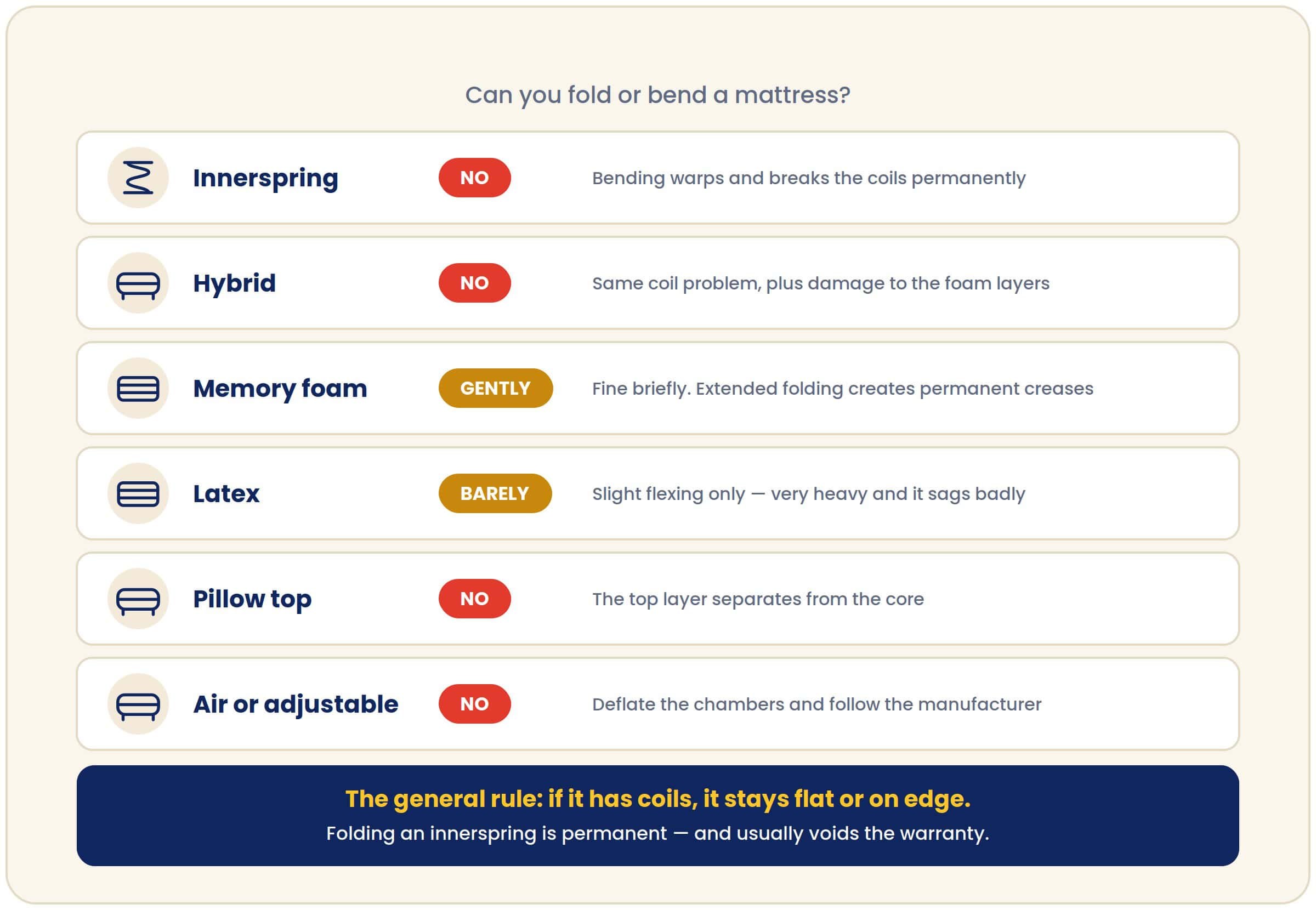
The general rule: if the mattress has coils, it stays flat or on edge. Do not leave it on edge for days at a time either, since foam layers settle unevenly.
How to Transport a Mattress Without a Truck
A cargo van or box truck is the right answer. Rent one for a few hours if a mattress is the only large item you are moving.
An SUV with the seats down works for a twin and sometimes a full. Measure before you commit.
A car roof is the option people reach for and the one that causes damage. If you do it, use a roof rack with crossbars and ratchet straps rather than rope or bungee cords. Never run straps through open windows; that warps door seals and frames. Keep the mattress from overhanging into your line of sight, stay off highways, and drive slowly. New York law requires loads to be secured, and a mattress that shifts or comes loose is both a ticket and a serious hazard to the cars behind you.
Roof of a sedan with no rack: skip it. The paint, the seals, and the mattress all lose.
If a rented truck is the plan, our truck rental guidance covers what size actually fits what.
Moving a Mattress Alone vs. With Help
One person can move a twin. One person can usually manage a full on a single floor with no turns.
A queen or king is a two-person job, and not only because of the weight. A king runs 100 to 150 pounds depending on construction, which is already a lot to carry alone. The bigger problem is size and flex. A mattress carried by one person folds around them, blocks their view of the stairs, and catches on every doorframe. That is how people fall.
If you are moving solo, the honest options are a second pair of hands, a hand truck with straps, or small-item moving help for the one piece you cannot do alone.
How to Store a Mattress the Right Way
If the mattress is going into storage between leases, storage conditions matter more than most people expect.
- Store it flat. Weeks or months on edge cause the foam and coils to settle out of shape.
- Keep it covered, but use a breathable cover for long-term storage. Sealed plastic traps moisture, and moisture creates mold.
- Do not stack anything on top of it.
- Choose climate-controlled space. Humidity swings in an uninsulated unit are what ruin mattresses in storage.
Gap days between leases are common in NYC, and furniture storage by the week solves the timing problem without putting your mattress in a friend’s damp basement.
Getting Rid of the Old Mattress in NYC
If the old mattress is not coming with you, New York City has a specific rule and it is enforced.
Mattresses and box springs must be fully sealed in a plastic mattress bag before they go to the curb. This is a bed bug containment rule, and it applies to the box spring exactly as it applies to the mattress. An unbagged mattress does not get collected, and enforcement can ticket the property owner. Penalties escalate with repeat violations and reach several hundred dollars, so check nyc.gov/dsny or call 311 for current amounts.
Set the sealed mattress out the evening before your building’s regular collection day, inside your posted set-out window, and use any bag color except red or orange. Collection day and set-out times vary by address, so confirm both with DSNY or 311 rather than assuming your old block’s schedule still applies.
The part people underestimate is the trip down. Stair rails and door latches tear plastic, and a torn bag at the curb counts as unbagged. Tape the seams generously and check the bag when you reach the sidewalk.
If bagging and carrying it down five flights is not realistic, mattress disposal as part of a move handles it from inside the apartment.
Common Mistakes That Damage Mattresses
- Dragging instead of carrying. Grinds the cover and picks up whatever is on the floor.
- Skipping the bag on a short move. Even a two-block move goes through a lobby, a sidewalk, and a truck bed.
- Folding an innerspring to fit a doorway. Permanent, and usually voids the warranty.
- Loading boxes on top of it in the truck. Compression marks do not come out.
- Leaving it on edge overnight in the new place. Lay it flat as soon as it is in the room.
- Guessing at elevator dimensions. Measure. A wasted trip on a Saturday costs more than five minutes with a tape measure.
When It Makes Sense to Hire Movers
Handling the mattress yourself makes sense when you are on a ground floor or have a working elevator, you have a second person, and you have access to a vehicle that fits it.
Bring in professionals when any of these apply:
- A fourth-floor walk-up or higher
- A queen or king with tight stairwell turns
- A building that requires a COI and an elevator reservation
- A new mattress still under warranty that you do not want to risk
- An old mattress that needs disposal on the same day
- A whole bedroom to move, not just the bed
At that point you are not paying for muscle. You are paying for building coordination, protection materials, and insurance if something goes wrong.
Get a Flat Rate Quote for Your Mattress Move
Moving a mattress is straightforward until a stairwell turn or an elevator reservation gets in the way. If your move involves a walk-up, a COI, or a full bedroom rather than a single item, see what is included with our NYC residential moving services or request a flat rate quote for your address.

EXPERT NYC MOVERS & STORAGE SOLUTIONS
Looking for the best place to get moving and storage solutions in NYC? Look no further than Lifestyle Moving & storage! We are the leading provider of moving and storage solutions in NYC, and we’re here to help make your move as pleasant as possible.
We are fully licensed and insured and offer a wide range of services to meet your moving and storage needs. We are a one-stop shop for moving and storage. Contact us today.
