




How to Move a Pool Table
 Lifestyle Moving & Storage

A pool table is not furniture. It is a precision instrument that happens to weigh as much as a small car, and it only plays right when the surface sits dead level. That is why moving one is a disassembly job, not a lifting job.
Short answer: take the table apart before you move it. Remove the pockets, then the rails, then the cloth, then the slate, then the frame and legs. Move each slate section on edge, padded and strapped. Reassemble in reverse order, seal the slate seams, level the surface with a precision level, and only then put the cloth back on. A 7-foot slate table runs around 700 pounds, an 8-foot table around 800, and a 9-foot tournament table can top 1,000. Nothing about that weight forgives a shortcut.
Below is the full process, what it costs, and the parts that catch New Yorkers off guard when the table has to leave a third-floor walk-up in Park Slope.
Can You Move a Pool Table Without Taking It Apart?
Almost never, and in most NYC buildings the answer is a flat no.
To slide an assembled table on dollies you need roughly 54 to 56 inches of clear width for a 9-foot table. Plenty of prewar doorways and hallway turns in Brooklyn, Queens, and the Bronx measure 28 to 32 inches. The math does not work, and no amount of muscle fixes it.
Even where clearance exists, moving a table intact stresses the frame joints and puts uneven pressure on the slate. Rails split. Joints pop. Slate cracks along a seam you cannot see until the balls start drifting.
There is one narrow exception: sliding a light MDF table a few feet within the same room on a flat floor. That is a room adjustment, not a move.
Before You Start: Tools, Crew, and Measurements
Get these sorted before a single screw comes out.
Tools
- Socket wrench set and a full screwdriver set
- Staple remover or flathead pry tool for the cloth
- Putty knife or thin pry bar for breaking the slate seams
- Rubber mallet
- Precision or machinist level
- Moving blankets, stretch wrap, and ratchet straps
- Heavy-duty furniture dollies rated for at least 1,000 pounds
- Labeled bags or a parts bin for hardware
- Shims for leveling at the destination
- Beeswax or a slate seam filler
Crew Four people minimum for a slate table. Six is better if stairs are involved. Each slate section weighs 150 to 250 pounds and has to be lifted and set down under control, not dropped the last two inches.
Measurements Measure the doorways, hallway widths, stair landings, and elevator interior before you commit. Write the numbers down. Then measure your longest slate section and your rail assemblies. If a stair landing is shorter than five feet and has a 90-degree turn, plan the pivot in advance rather than discovering it mid-lift.
How to Move a Pool Table, Step by Step
1. Photograph everything
Before you touch a fastener, shoot photos of the underside, the rail bolts, the pocket attachments, and the slate seams. Reassembly is much faster when you can see how it came apart. Bag and label every screw by the part it came from.
2. Remove the pockets
Pockets are either stapled or bolted to the rails. Staples come out with a staple remover. Bolted pockets unscrew from underneath. Keep the corner pockets and side pockets in separate labeled bags, since the two sets are shaped differently and are not interchangeable.
3. Remove the rails
Rail bolts sit on the underside of the table, usually two or three per rail. Back every bolt off partway before you remove any of them, so no single rail ends up carrying the tension of the others. Lift the rails straight up so the cushions do not scrape the slate. Wrap each rail individually and set them somewhere they will not get stepped on.
4. Take off the cloth
If the cloth is stapled, work the staples out slowly along each edge. If it is glued, peel from a corner with steady pressure and no yanking. Decide in advance whether you are reusing it. Cloth older than a few years, or already showing wear at the pockets, is usually easier to replace than to save. Reusing cloth that tears mid-removal costs you the cloth anyway.
5. Unfasten and lift the slate
Most quality tables use a three-piece slate bed. Remove the screws at the slate seams, then work a putty knife or thin pry bar into the seam to break the beeswax seal. Lift each section with at least two people per slab, more for a one-piece slate.
Handle slate on edge. Slate is dense, roughly 168 pounds per cubic foot, and it fails under bending stress. Carrying and transporting sections vertically, padded and strapped upright, is far safer than laying them flat where an unsupported center can crack.
Never set slate on an uneven surface, never stack sections directly on each other, and never rest a section against a wall unsecured.
6. Break down the frame and legs
Unbolt the legs, then the frame sections. Wrap the legs individually because they are the parts most likely to get dinged in the truck. Keep frame hardware in its own labeled bag.
7. Load and transport
Load slate first, upright and strapped against the truck wall so it cannot shift. Rails, legs, and frame go in blanket-wrapped and secured. Everything in the truck should be immobile before the doors close. Road vibration over a long distance is exactly what turns a hairline flaw into a crack, which is why slate gets crated rather than blanket-wrapped on long distance moving jobs.
8. Reassemble in reverse
Frame and legs first, squared and shimmed until stable. Then the slate sections, aligned at the seams and screwed down. Then seal the seams with beeswax. Level the table at this point, before any cloth goes on. Only then does the cloth go back, followed by the rails and finally the pockets. If furniture assembly is not something you enjoy, this is the stage to have help on hand.
9. Level it properly
This is the step that decides whether the table plays or just looks like a table. Set your precision level across the bare slate in multiple directions and shim under the frame until the surface is true. Professional installers work to within about a hundredth of an inch. Check again after the rails go back on, since tightening rail bolts can shift things.
Roll a ball slowly across the surface in several directions as a final test. If it curves, keep shimming.
10. Stretch or replace the cloth
Cloth has to be stretched evenly and secured without wrinkles or slack. This is the part most DIY moves get wrong in a way you feel every time you play. Budget for new cloth if the old one has any age on it.
Plan on 4 to 6 hours for the full process. Tables with a ball return system run closer to 6 to 8 hours because of the extra disassembly.
Moving a Pool Table in a NYC Apartment or Brownstone
This is where a pool table move stops being about billiards and starts being about buildings.
Your COI comes first. Most co-ops, condos, and managed buildings will not let a crew past the lobby without a Certificate of Insurance naming the building and management company. Request it early. A table sitting in pieces in your living room because the paperwork is not cleared is a wasted day.
Book the freight elevator, and measure it. Elevator time windows in NYC buildings are limited and often restricted to weekday business hours. Measure the car interior. Slate sections stood on edge usually fit where an assembled table never would.
Walk-ups need a plan, not enthusiasm. Narrow stairwells with tight landings are the hardest environment for slate, and our Brooklyn movers see this constantly in brownstone and prewar walk-ups. Every pivot has to be planned. This is where crew size stops being optional.
Brownstone stoops and basement stairs. Exterior stairs, iron railings, and low basement ceilings all reduce your working room. Check the path in daylight before move day.
Loading zone and street access. Figure out where the truck legally parks and how far the carry is. On a narrow Manhattan block that carry distance matters more than the mileage.
Floor load in older buildings. An 800-pound table concentrated on six legs is real weight for an old floor. If you are placing a table on an upper floor of a prewar building, it is worth confirming with your building or a structural professional before installation.
What It Costs to Move a Pool Table
Industry cost data from HomeGuide and Angi puts a typical local professional pool table move between $300 and $800. National figures run wider, roughly $375 to $1,500, because those averages fold in longer transport distances and larger tables. At the far end, a big tournament table moved interstate with difficult access can approach $4,000.
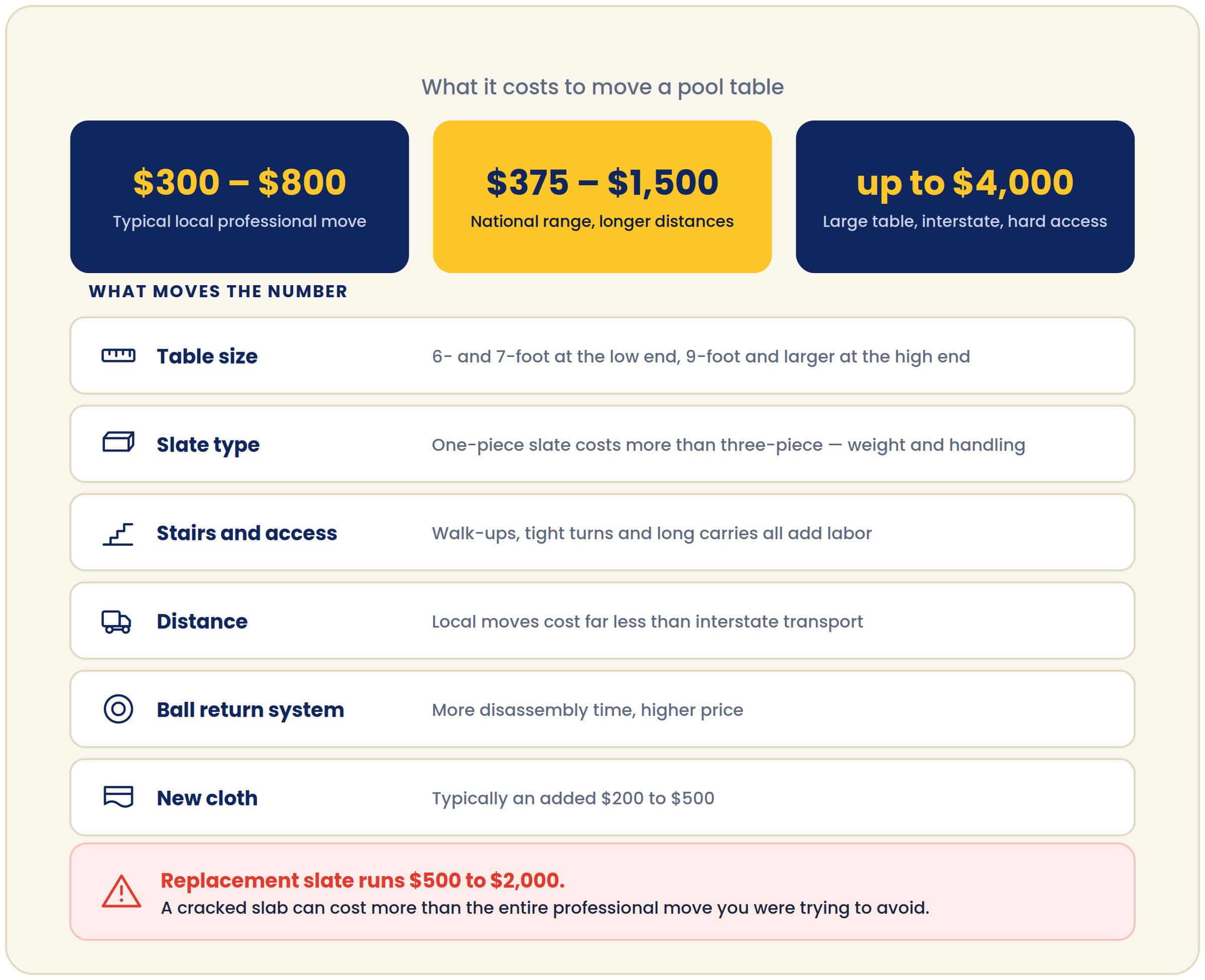
One number worth keeping in mind: replacement slate commonly runs $500 to $2,000, and it is often harder to source than the price suggests. A cracked slab can cost more than the entire professional move you were trying to avoid.
Mistakes That Wreck Pool Tables
- Moving the table assembled because the hallway “looks wide enough”
- Carrying slate flat instead of on edge
- Skipping labeled hardware bags, then guessing at reassembly
- Pulling stapled cloth fast and tearing it
- Setting slate directly on concrete or on top of another slab
- Calling the job done without leveling, then blaming the table for bad rolls
- Booking a crew of two friends for an 800-pound object
DIY or Hire Movers?
Do it yourself if: the table is a lighter MDF or wood-bed model, you are staying on one floor, you have four or more capable helpers, and you are comfortable with the leveling step.
Hire professionals if: the table has slate, stairs or elevators are involved, the table is worth more than about $1,000, or you are moving between buildings. In NYC, that covers nearly every real move.
A slate pool table is heavy, fragile, and unforgiving of small errors, which is a fair description of the specialty items we move most often: pianos, gym equipment, and heavy furniture. The equipment and the sequence matter more than raw strength.
Get a Flat-Rate Quote for Your Pool Table Move
Planning a move with a pool table in the mix? Tell us the table size, the slate type, and your building access, and we will confirm a flat-rate price with the crew size the job actually needs. See our apartment moving and furniture moving services, or call us.

EXPERT NYC MOVERS & STORAGE SOLUTIONS
Looking for the best place to get moving and storage solutions in NYC? Look no further than Lifestyle Moving & storage! We are the leading provider of moving and storage solutions in NYC, and we’re here to help make your move as pleasant as possible.
We are fully licensed and insured and offer a wide range of services to meet your moving and storage needs. We are a one-stop shop for moving and storage. Contact us today.
