




Moving In Together in NYC: How to Merge Two Apartments Without Losing Your Mind
 Lifestyle Moving & Storage

Merging two apartments is not one move. It is two move-outs, one move-in, and a series of decisions about furniture that most couples have never had to make together before.
The short version: decide whose lease you are keeping first, run a duplicate audit second, and book storage before moving day rather than after. Couples who do those three things in that order tend to have an uneventful move. Couples who skip straight to booking a truck tend to discover on the day that two sofas do not fit in one living room.
Here is how to work through it.
Step One: Decide Where You Are Actually Living
Everything else follows from this. It is also the decision most couples put off longest, because it is the one with feelings attached.
There are three options, and they are not equivalent.
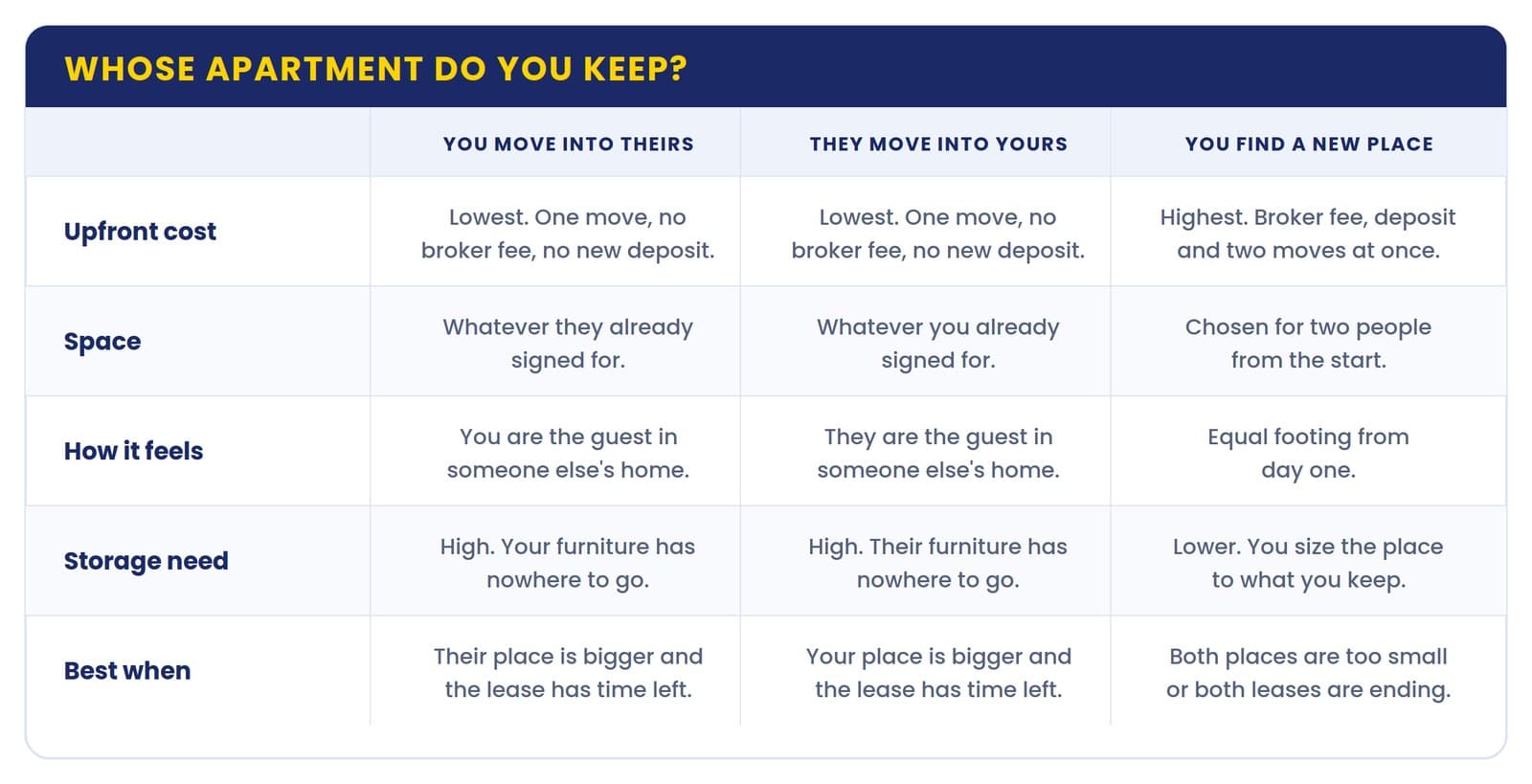
Moving into an existing apartment is dramatically cheaper. No broker fee, no new security deposit, one move instead of two. In a city where upfront rental costs regularly run into five figures, that is not a small consideration.
The trade-off is that whoever moves in is moving into someone else’s home, with someone else’s furniture already in place and someone else’s habits already established. That is manageable, but it is worth naming out loud rather than discovering three months later.
Finding a new place together costs the most and solves the most. It is the right call when both apartments are too small, when both leases are ending anyway, or when the “whose place” conversation is genuinely stuck.
One practical note: if you are keeping one lease, check whether adding a person requires landlord approval. Many New York leases do, and some buildings run a full application on the incoming partner. Start that process early, because approval can take weeks and it determines whether the move date is even legal.
Step Two: Work Out Your Lease Timing
Leases almost never line up neatly. What matters is which of the three common situations you are in, because each has a different fix.
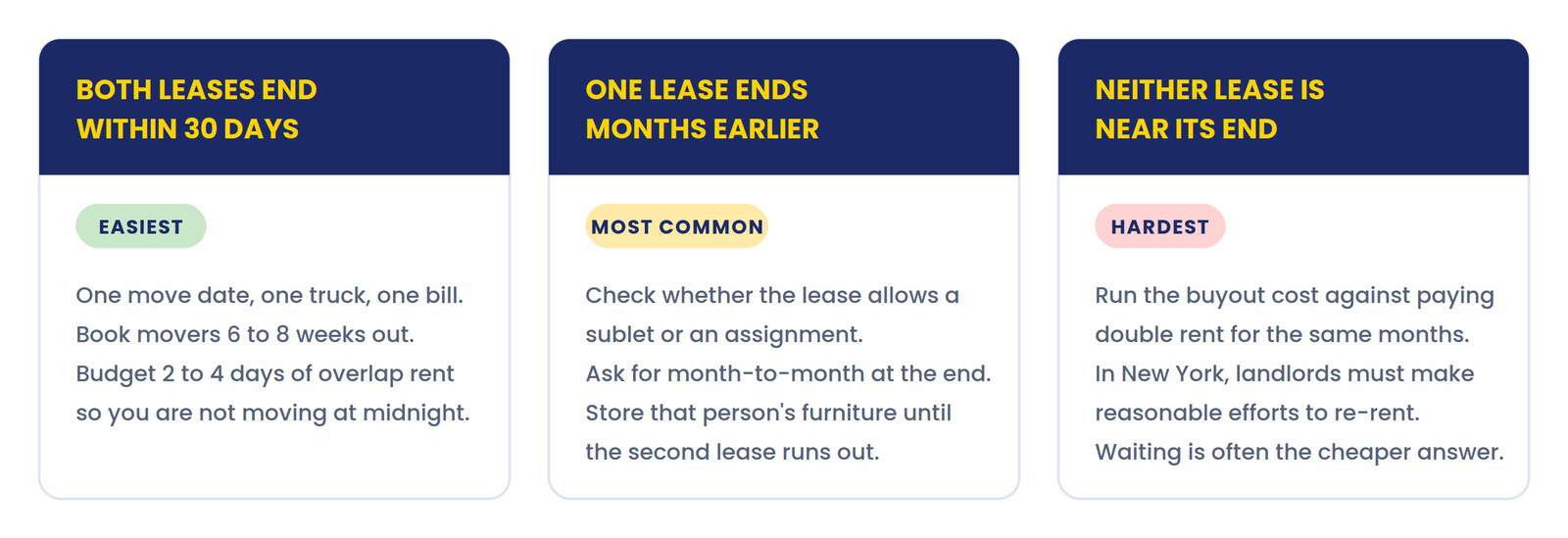
If one lease ends months before the other, the usual answer is not to break it — it is to move that person in early and store their furniture until the second lease runs out. Storage for a few months is almost always cheaper than a lease-break penalty, and it removes the pressure to make furniture decisions in a hurry.
If neither lease is near its end, do the arithmetic before doing anything else. Compare the cost of a negotiated buyout against the cost of paying rent on two apartments for the remaining months. Note that in New York, landlords have a duty to make reasonable efforts to re-rent a vacated apartment rather than simply billing the departing tenant for the balance of the lease. That changes the negotiating position considerably, and it is worth understanding before any conversation with a landlord.
(This is general information, not legal advice. Read your lease and speak to a tenant attorney if a large sum is at stake.)
Budget for overlap either way. Even in the best case, plan for a few days when you are paying for both apartments. Trying to move out, clean, and hand back keys on the same day you move in is how moves go wrong.
Step Three: Run the Duplicate Audit
This is the part that causes arguments, and it is entirely avoidable if you do it before the boxes are packed rather than after they are unpacked.
Two full apartments contain two of nearly everything. Some of those duplicates are useful. Most are not. And a few of them are attached to memories, which is why “just get rid of it” is bad advice.
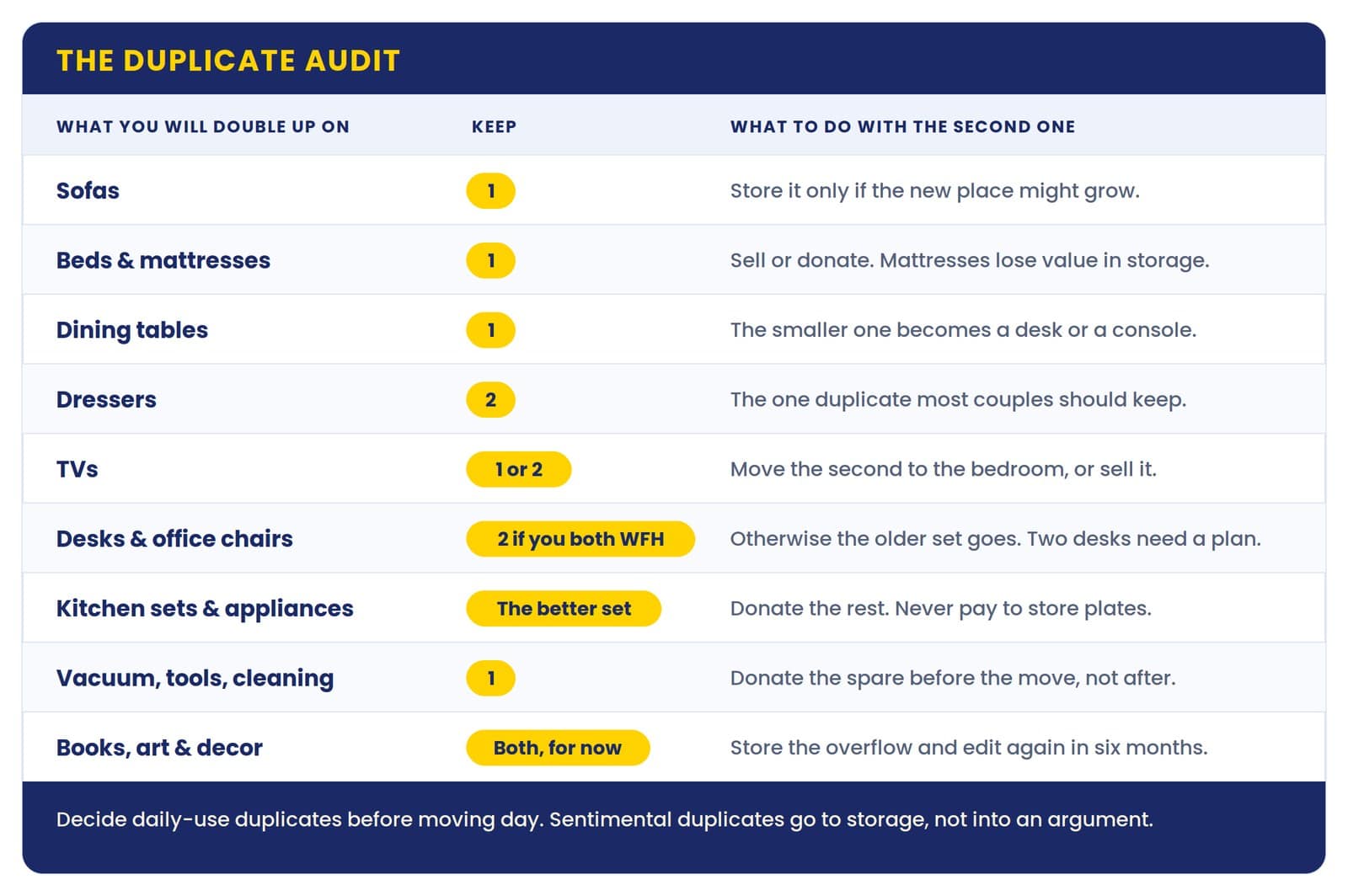
Work through the list together, in the same room, before moving day. Three rules make it go faster:
Decide daily-use duplicates now. Sofas, beds, dining tables, kitchen equipment. These get used every day, they take up the most space, and there is a clear right answer for each. Make the call and move on.
Never pay to store consumables. Plates, pots, cleaning supplies, towels, cheap flat-pack furniture. Storing these for six months costs more than replacing them. Donate or sell before the move.
Send sentimental duplicates to storage rather than to a fight. The chair from a grandparent, the desk someone wrote a dissertation at. If one person is not ready to let go of an item and it does not fit, storage is a legitimate answer and a cheap one. Revisit in six months, when the new apartment feels like home and the decision is easier. This is a much better outcome than winning the argument.
The one duplicate almost every couple should keep is dressers. Two people rarely share one comfortably, and closet space in New York apartments is not going to bail you out.
Step Four: Plan a Two-Pickup Move
A move with two origin addresses and one destination is a different job from a standard apartment move, and most people do not realise it until they are getting quotes.
What changes:
Timing. Two buildings mean two sets of access rules, potentially two elevator reservations, and two windows to hit. If both buildings require a certificate of insurance, both need one issued in advance — and each building’s management may want specific wording. Our guide to certificates of insurance covers what to ask for.
Sequencing. The load order matters. Whichever apartment’s furniture is going into storage should generally be loaded last and unloaded first, so it is not buried behind everything else.
Labelling. With two origins, “kitchen” is no longer a sufficient label. Use initials or colours so the crew knows which kitchen box belongs to which set, and so the unpacking does not turn into an excavation.
Pricing. A two-pickup move takes longer than a single-origin move of the same total volume, because of the extra travel, the second building’s access, and the second protection setup. Get that reflected in the estimate up front rather than discovering it as an add-on. Our apartment moving service handles multi-pickup moves across all five boroughs.
If the two apartments are in different boroughs, mention that when requesting a quote. Bridge and tunnel timing genuinely affects how long the day takes.
Step Five: Set Up the New Place for Two People
The unpacking phase is where couples find out whether the audit worked.
Give each person a defined zone. A closet, a shelf, a drawer, a corner. Not shared, not negotiated. It sounds minor and it prevents a surprising number of arguments.
Solve the work-from-home problem before moving day, not after. If both of you take calls, two desks in one room is a plan that fails within a week. Decide in advance whether that means a divider, staggered schedules, or one person working from a different room.
Do not unpack everything at once. Leave the non-essential boxes closed for a few weeks. You will learn what the apartment can actually hold, and the things still in boxes at the end of that period are the things that should go.
Expect to over-import. Almost every couple brings more than the new place can take, even after a careful audit. That is not a failure of planning; it is the reason short-term storage exists. Booking a small unit for three months is far cheaper than making rushed decisions in the last week of a lease.
What This Usually Costs
The honest answer is that it varies enormously, but the cost drivers are predictable:
- Whether you keep an existing lease or sign a new one. This is the largest single variable by a wide margin.
- Two pickups instead of one. Adds time, and time is how local moves are priced.
- Building access at both addresses. Walk-ups, long carries and restricted elevator windows all add hours.
- Storage. Usually the smallest line item, and often the one that saves money elsewhere by preventing panic decisions.
- Overlap rent. A few days of double rent, which is worth paying.
For a realistic picture of what drives a New York moving quote, moving cost estimates breaks down how local movers price a job.
A Timeline That Works
8 to 10 weeks out — Decide whose apartment, or start looking together. Check whether the lease requires landlord approval to add a tenant.
6 to 8 weeks out — Give notice on the apartment you are leaving. Book movers, especially if moving between May and September. Confirm both buildings’ move-in rules and COI requirements.
4 weeks out — Run the duplicate audit. Book storage if you need it. Start selling and donating, which takes longer than anyone expects.
2 weeks out — Order packing supplies. Confirm elevator reservations at both buildings. Send the mover the final inventory, including what is going to storage.
1 week out — Pack, labelled by person as well as by room. Update addresses. Confirm the arrival window.
Moving day — Two pickups, one delivery, storage load handled separately.
Six months later — Revisit the storage unit. Whatever you have not missed can go.
Moving Two Apartments Into One NYC Home
Merging two apartments into one? Our apartment moving service covers multi-pickup moves across the five boroughs, and short-term storage is there for whatever does not fit on day one.

EXPERT NYC MOVERS & STORAGE SOLUTIONS
Looking for the best place to get moving and storage solutions in NYC? Look no further than Lifestyle Moving & storage! We are the leading provider of moving and storage solutions in NYC, and we’re here to help make your move as pleasant as possible.
We are fully licensed and insured and offer a wide range of services to meet your moving and storage needs. We are a one-stop shop for moving and storage. Contact us today.
