




What Size Storage Unit Do I Need?
 Lifestyle Moving & Storage
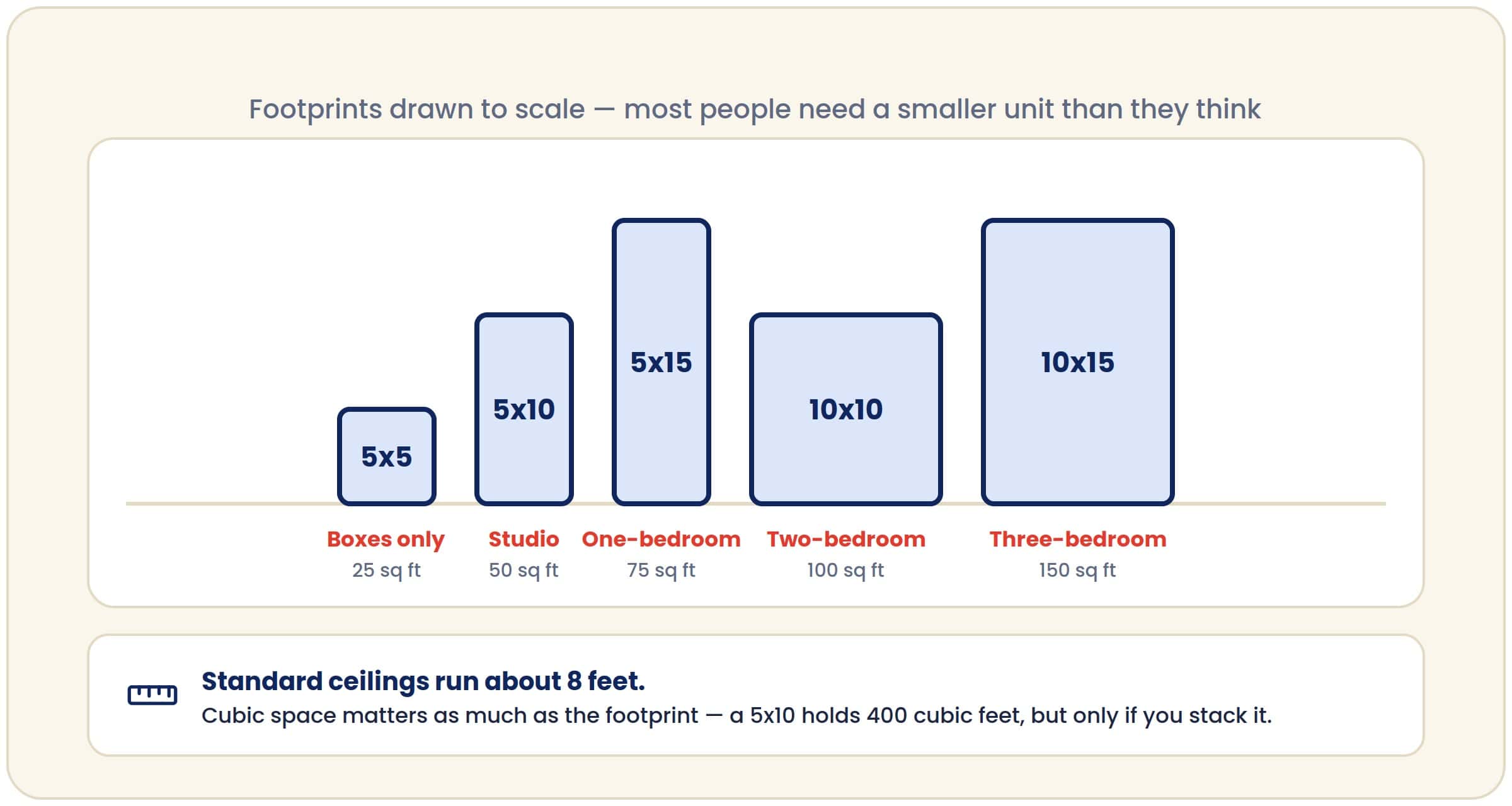
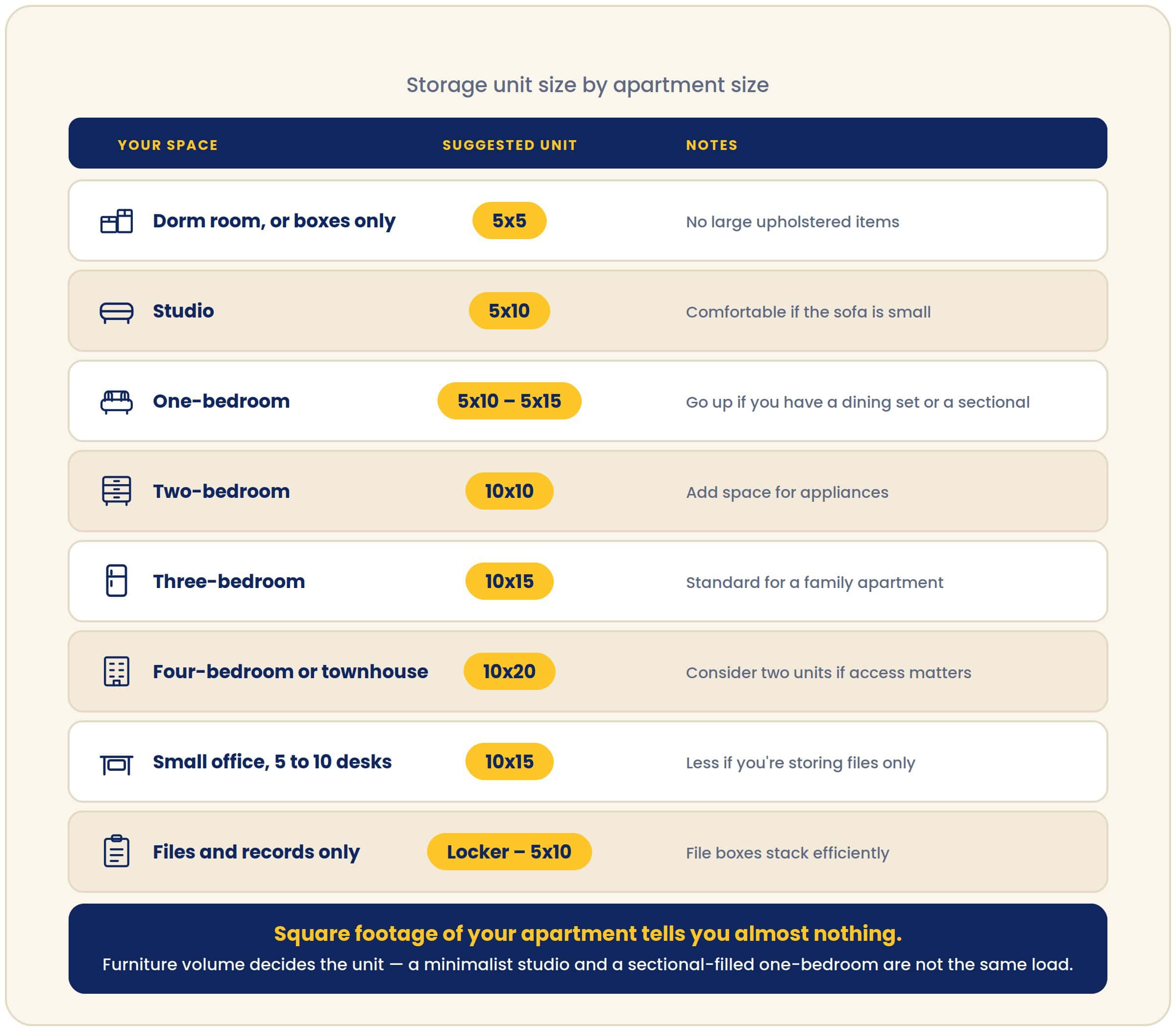
Most people need a smaller unit than they think. As a quick answer: a studio fits in a 5×10, a one-bedroom apartment usually fits in a 5×10 or 5×15, a two-bedroom needs a 10×10, and a three-bedroom apartment or brownstone floor usually calls for a 10×15. If you are only storing boxes, seasonal clothes and a few small items, a 5×5 is enough.
That is the short version. The right size depends on how much furniture you are storing, how well it is packed, and whether you need to walk into the unit or just close the door and forget about it until your next lease starts. Below is the full size chart, what actually fits in each unit, and how to size your own load in about ten minutes.
Storage Unit Size Chart
Standard ceilings run about 8 feet, so cubic space matters as much as the footprint.
Many New York City facilities also carry sizes you will not see in the suburbs, including narrow lockers and 5×8 or 8×10 units. If your load falls between two sizes, ask what odd sizes are available before you jump up a full tier.
What Fits in Each Storage Unit Size
5×5 Storage Unit
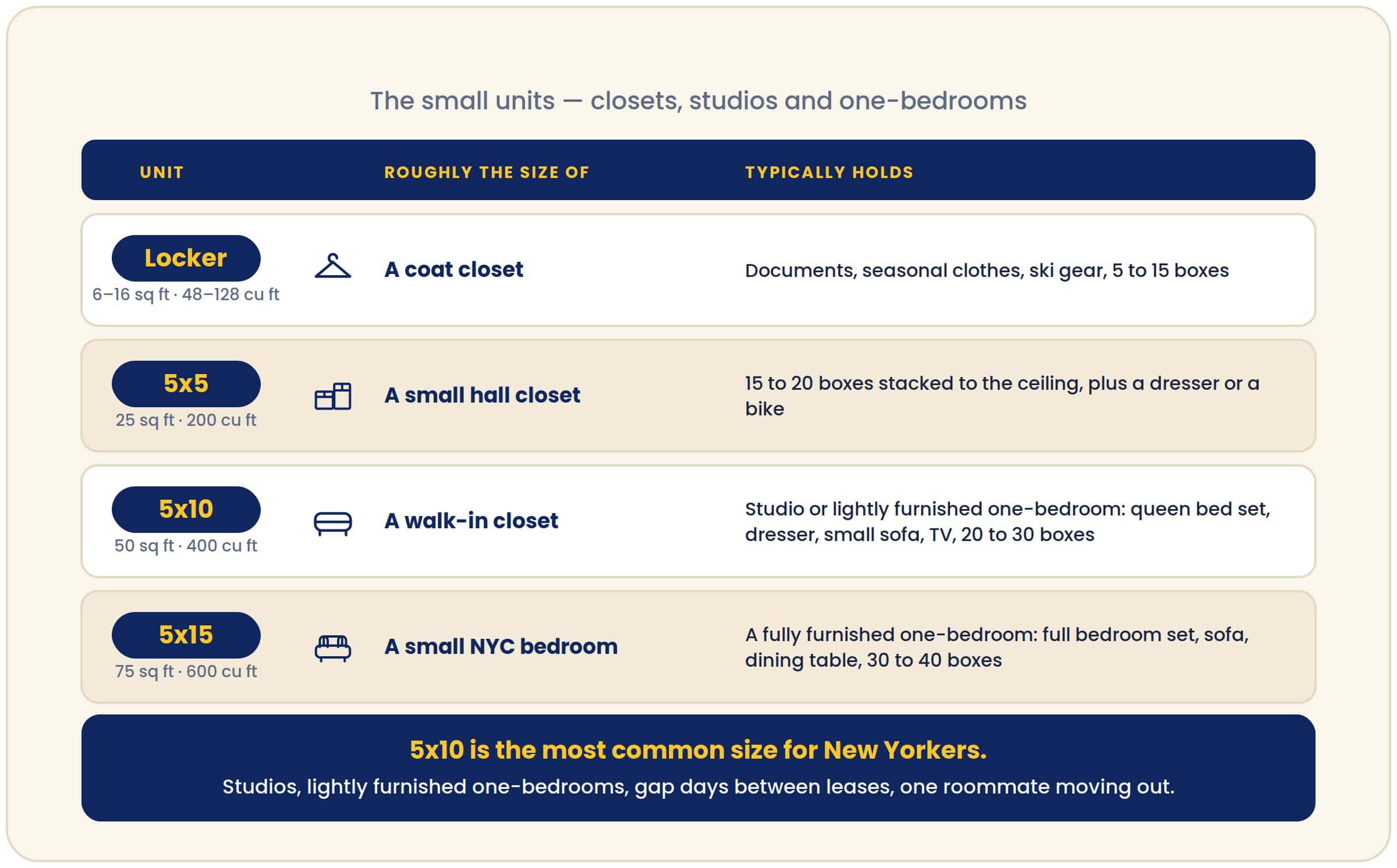
The closet unit. It holds roughly 15 to 20 medium boxes stacked to the ceiling, plus a dresser or a bike. It is the right call for seasonal storage, a student’s summer break, or a bedroom cleared before a renovation.
Good for: boxes, books, clothing, holiday decorations, small furniture. Not good for: anything with a sofa in it.
5×10 Storage Unit
The most common size for New Yorkers. A 5×10 holds a studio apartment or the contents of one furnished bedroom: a queen mattress and box spring on their sides, a dresser, a nightstand, a loveseat or small sofa, a TV, and 20 to 30 boxes packed around them.
Good for: studios, lightly furnished one-bedrooms, gap days between leases, one roommate moving out. Not good for: a one-bedroom with a dining set and a large sectional.
5×15 Storage Unit
A narrow but deep unit that works well when you have long items such as a sofa, a dining table or a mattress set. It handles a fully furnished one-bedroom apartment. The tradeoff is access, since anything at the back is hard to reach without unloading the front.
Good for: one-bedroom apartments, long-term storage you will not touch.
10×10 Storage Unit
The workhorse. A 10×10 takes a large one-bedroom or a modest two-bedroom: two bedroom sets, a sofa, a dining table and chairs, a washer or dryer, plus 40 or more boxes. It is also wide enough to leave a walking path down the middle if you need to get in regularly.
Good for: two-bedroom apartments, couples combining households, renovations that pull an entire floor of furniture.
10×15 Storage Unit
Handles a two- or three-bedroom apartment including appliances, mattresses, a full living room and bulky items such as a Peloton, a treadmill or a large sectional. This is also the practical size for a small office relocation with desks, chairs and file cabinets.
Good for: three-bedroom apartments, brownstone floors, small offices.
10×20 Storage Unit
The size of a one-car garage. It fits a three- or four-bedroom home, a vehicle, or a full office with workstations. At this size, how the unit is loaded matters more than the square footage. Professional loading can yield up to a third more usable space than a rushed self-load.
Good for: townhouses, full home relocations, commercial storage.
10×30 Storage Unit
Rare in Manhattan and usually found in outer-borough facilities. Reserved for four- and five-bedroom homes, contractors, and businesses holding inventory or archives.
Storage Unit Size by Apartment Size
How to Size Your Own Storage Unit in Three Steps
Step 1: Inventory the big items, not the rooms
Square footage of your apartment tells you almost nothing about the unit you need. A 700-square-foot one-bedroom with a sectional, a dining table and a bed frame takes far more storage space than a 700-square-foot minimalist studio. Walk each room and list only the items that will not stack: sofas, mattresses, tables, dressers, appliances, bikes, exercise equipment, artwork.
Step 2: Count your boxes
Everything else becomes boxes. Roughly 20 medium boxes fill a 5×5 when stacked to the ceiling. If you are not sure how many boxes your apartment will produce, a good working figure is 10 to 15 boxes per room for a lightly furnished apartment and 20 to 30 per room for a fully lived-in one. Uniform box sizes stack tighter and give you more usable space than a mix of random cartons.
Step 3: Add space for access
Decide whether this is deep storage or active storage.
Deep storage means you load it, lock it and open it when your new lease starts. Pack wall-to-wall and ceiling-high. Use the size chart as is.
Active storage means you will pull items out through the season. Leave a center aisle, keep frequently used items near the door, and step up one size from what the chart suggests.
Do You Need Climate-Controlled Storage in New York City?
New York summers are humid, and winters get cold. Most storage in the five boroughs sits in multi-story buildings rather than outdoor drive-up rows. Climate control is worth it for wood furniture, leather, artwork, electronics, musical instruments, photographs, documents, and anything upholstered. For plastic bins of holiday decorations or metal shelving, standard units are fine.
If you are storing anything you would be upset to see warped, cracked or mildewed, choose climate-controlled storage and keep items off the concrete floor on a pallet or a layer of cardboard.
Five Mistakes That Lead to the Wrong Unit Size
- Sizing by apartment square footage. Your furniture volume decides the unit, not your floor plan.
- Ignoring vertical space. A 5×10 holds 400 cubic feet, but only if you stack it. Half-loaded units are the single most common reason people rent a size larger than they need.
- Renting bigger just in case. In New York City you pay by the square foot in one of the most expensive markets in the country. One tier too large, held for a year, is real money spent on air.
- Not measuring your largest single item. A sectional, an armoire or a king box spring has to clear the unit door and the freight elevator. Measure the widest and longest piece before you book.
- Assuming you can pull a truck up to the door. Drive-up access is rare in Manhattan and most of Brooklyn. Plan for a loading dock, a freight elevator and a reserved time window, which is the same logistics work a building move requires.
When a Storage Unit Is Not the Right Answer
A traditional unit is not always the best fit.
Short gaps between leases. If you are storing for two weeks between a move-out and a move-in, look at short-term storage with prorated billing rather than a full-month commitment.
You do not want to visit a facility. Portable storage and pod rental bring the container to your building, which removes the truck rental and the loading dock puzzle entirely.
Only a few large items. Storing one sofa and a dining set often works out cheaper through furniture storage priced by the item rather than renting a unit you will half fill.
Business records. Files and inventory belong in document storage or archive storage, where boxes are indexed and retrievable rather than buried behind furniture.
Get the Right NYC Storage Unit Size Without Guessing
If you are still between two sizes, the fastest way to settle it is a quick inventory review. Our team sizes storage for New York City apartments and offices every week, and we can tell you what your load actually needs before you commit to a monthly rate. Take a look at our NYC storage services for climate-controlled units by the week or month, or call us and we will walk your inventory with you.

EXPERT NYC MOVERS & STORAGE SOLUTIONS
Looking for the best place to get moving and storage solutions in NYC? Look no further than Lifestyle Moving & storage! We are the leading provider of moving and storage solutions in NYC, and we’re here to help make your move as pleasant as possible.
We are fully licensed and insured and offer a wide range of services to meet your moving and storage needs. We are a one-stop shop for moving and storage. Contact us today.
