




How Much to Tip Movers in NYC
 Lifestyle Moving & Storage

Here’s the short answer: most people tip $30 to $50 per mover for a standard local move, $50 to $100 per mover per day on a long-distance move, or 10% to 20% of the total bill split across the crew on mid-sized full-service jobs. Prefer to think hourly? $5 to $10 per mover per hour lands in the same place.
Now the longer answer, because if you’re moving in New York, those national numbers only get you halfway there.
A four-hour move in a Brooklyn brownstone with no elevator and no legal parking is not the same job as a four-hour move in a Long Island City high-rise with a loading dock. Same clock, completely different day for the crew. Your tip should reflect that, and this guide walks you through exactly how to land on a number you actually feel good about handing over.
Tipping is never required. No moving company can add a tip to your invoice, and no crew is owed one. It’s a thank-you for hard physical work done well.
Tipping Movers at a Glance
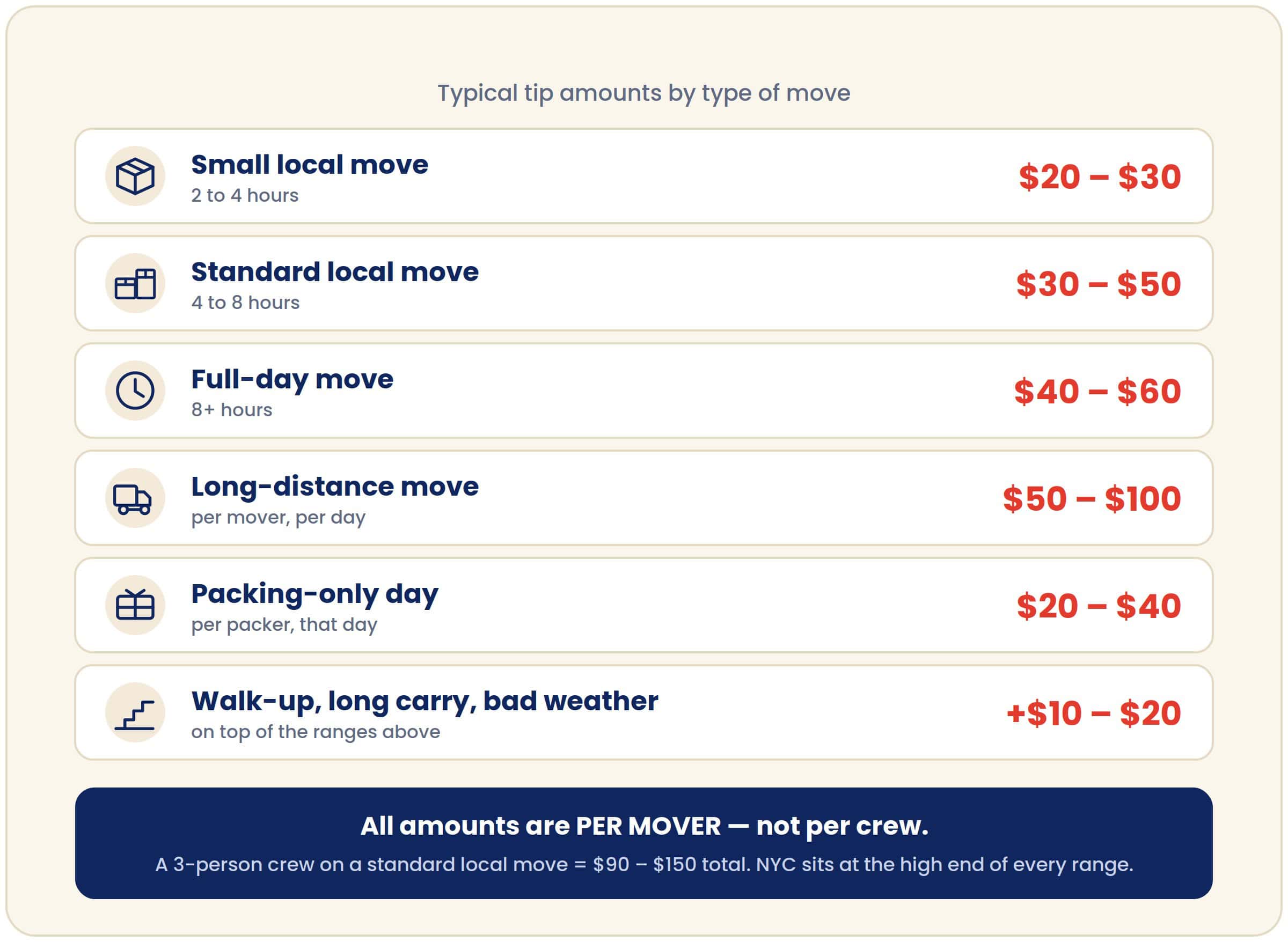
These are per person, not per crew. A three-mover team on a standard local move comes to roughly $90 to $150 total.
And a note New Yorkers already suspect is true: NYC runs at the higher end of every one of these ranges. Cost of living, degree of difficulty, and local expectation all push it there.
The Two Ways to Calculate a Tip (And Which One to Use)
There are really only two methods people use. Picking the right one matters more than agonizing over the exact dollar amount.
Per-mover method. Pick a flat amount per crew member, or an hourly rate per crew member. Best for local, hourly, and labor-only jobs, because it stays tied to the number of people who actually did the lifting.
Percentage method. Take 10% to 20% of the total bill and split it across the crew. Best for mid-sized full-service moves where packing, materials, and specialty handling have pushed the invoice into the thousands.
The Rule of Thumb
Flat per-mover rate under about $1,500. Percentage in the middle range, roughly $1,500 to $10,000. Then back to per-mover-per-day on very large relocations.
Here’s why that matters at the bottom end. A $500 local move at 10% is $50 total, for the whole crew, not per person. Split between two movers who just carried your sofa down four flights in August, that’s $25 each. Nobody intends to undertip that badly. The math just does it for you quietly.
Percentages break down at the top end too. A $14,000 NYC-to-LA relocation at 15% is $2,100, and most of that invoice is fuel, mileage, tolls, and truck time, not crew labor. On moves that size, per-person-per-day amounts stay much closer to reality, which is why the percentage method has a ceiling as well as a floor.
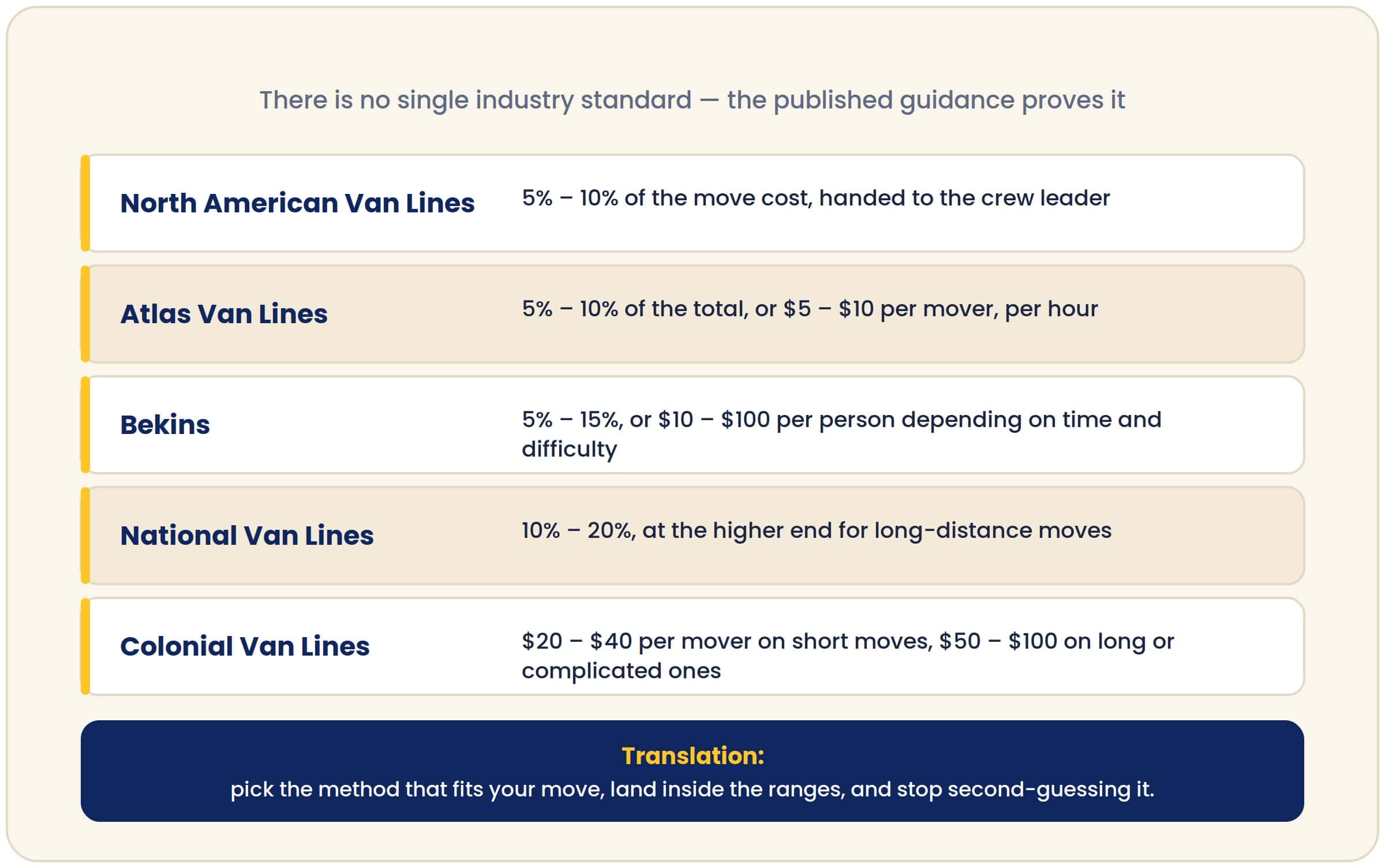
What the Major Van Lines Actually Recommend
Tipping Local Movers: What It Looks Like in Practice
Local moves are the easiest to tip because you watch the entire job. One crew, start to finish, usually billed hourly.
Say you’re moving a two-bedroom from Park Slope to Astoria. Three movers, six hours, second-floor walk-up on the pickup side, elevator building on the delivery side. Nothing broken, no drama. At $40 per mover, that’s $120 total. Fair.
Now change one variable. Make it a fourth-floor walk-up with a stoop, in July, with the truck double-parked a block away because the block was taken. Same six hours, dramatically harder day. $50 to $60 per mover is the right call.
Don’t underpay the small jobs. A studio move that takes two hours is where people tip worst. The crew still got dispatched, still protected your stuff, still probably drove an hour to reach you through Brooklyn traffic. $20 to $30 per mover is a fair floor even when the job is short.
Tipping Long-Distance Movers: Watch for the Second Crew
Long-distance moves come with a wrinkle a lot of people don’t see coming: the crew that loads your truck in Manhattan is often not the crew that unloads it in Miami. Weeks can pass between the two.
When there are two crews, tip each one separately, at the end of its own portion of the job. Don’t hold back a lump sum on loading day planning to divide it later. You’ll never see that first crew again, and you can’t grade the second crew’s work before they’ve done it.
A practical split:
- Loading crew: $40 to $60 per person. Usually the harder half. Disassembly, wrapping, inventory tagging, and the three-dimensional puzzle of packing a trailer so nothing shifts across 1,300 miles of I-95.
- Unloading crew: $30 to $50 per person. Typically faster, though furniture placement and reassembly can even it out.
If the same crew handles the whole move door to door, one tip of $50 to $100 per mover per day is standard.
Ask before moving day. Put one question to your move coordinator: same crew on both ends? Your tipping budget stops being guesswork.
Do You Tip Packers Separately?
Yes, when packing is handled by a separate crew or on a separate day.
Packing is skilled work, not just box-filling. Wrapping stemware, crating a mirror, prepping a piano, labeling accurately so unpacking isn’t a scavenger hunt. That’s what keeps your things intact and keeps you off the phone with a claims department later. A packing day typically earns $20 to $40 per packer, handed over at the end of that day.
If the same crew packs and moves on the same day, don’t double up. Just bump the single tip by roughly 15% to 25% to account for the extra service.
When to Tip More (And When to Tip Less)
The invoice doesn’t capture difficulty. These things do.
Tip above the range when:
- It’s a walk-up at either end, and add more for every flight past two
- The truck couldn’t park close, so every item became a long carry. A five-block carry in August isn’t really five blocks, not for you and not for them
- The building gave the crew a tight freight elevator window and they hustled to beat it
- They handled a piano, safe, treadmill, pool table, or an antique that made you nervous
- The weather was genuinely brutal: July heat, February ice, rain all day
- The job ran long because of building access issues that weren’t their fault
- They solved something you couldn’t have, like getting a sectional through a window or around a staircase that had no business fitting it
Tip less, or not at all, when:
- The crew showed up hours late with no communication
- Something got damaged through carelessness and nobody acknowledged it
- They were unprofessional, or spent the job on their phones
- An hourly job dragged with no explanation
Reducing a tip isn’t rude. Tipping is a reward for service. That’s the entire mechanism that makes it mean something.
And you can tip crew members unequally. If one person clearly carried the job and another coasted, giving one $60 and the other $30 is completely appropriate. Most customers have no idea this is an option.
How to Actually Hand It Over
Cash, ideally. Most companies have no clean way to split a card tip across a crew, and some route card gratuities through payroll, where they land late. If you’re tipping electronically, just confirm with the office that the money goes directly to the crew.
Get it before moving day. Hit the ATM the day before. On move day your wallet is in a box, your phone is at 12%, and the nearest bank is four avenues away.
Envelopes help. One per crew member, amounts already inside. Takes two minutes the night before, removes the awkward math at the door.
Tip at the end, after the last item is placed and the paperwork is done. On a long-distance move, that means at the end of each crew’s portion.
Hand it to each person directly when you can. Giving the full amount to the foreman is normal and fine, but individual handoffs guarantee the split you intended and let you thank people face to face.
Don’t announce it in advance. It changes the whole dynamic and starts to feel like a bribe instead of a thank-you.
Wait, What About the Doorman and the Super?
This is the NYC question the national guides skip entirely.
If your building’s super held the freight elevator, unlocked the service entrance, kept the loading area clear, or coordinated with your management company on the certificate of insurance, that’s real help and it’s separate from your movers. $50 to $100 to the super is common on a full-service move in a doorman or elevator building. A doorman who spent the afternoon managing the traffic your move created in the lobby usually warrants $20 to $40.
It’s the kind of thing that makes the next building request (a repair, a delivery, a favor) go a lot more smoothly.
Are You Ever Obligated to Tip?
No. And there’s one situation that deserves a hard flag.
If a crew brings up a tip before the job is done, or hints that the amount will affect how carefully your things get handled or how fast the truck gets unloaded, that’s not an etiquette question. That’s a red flag. Legitimate crews are paid by their employer and don’t ask for anything until the work is finished.
If a crew refuses to unload until you pay something beyond the agreed price, that’s a hostage-load situation. For interstate moves, the Federal Motor Carrier Safety Administration publishes your rights as a shipper and takes complaints, and the Federal Trade Commission has guidance on spotting moving scams. Document everything and don’t pay under pressure at the curb.
This is also why the company you book matters more than the tip you plan. A licensed, insured mover with a real dispatch office and a written estimate doesn’t put you in that position in the first place.
If Tipping Isn’t in the Budget This Time
Moving in New York is expensive, and nobody needs to apologize for a tight budget. Crews notice these too:
- Cold drinks, coffee, lunch. On an eight-hour summer move this actually lands. Ask any crew.
- A clear path and clear parking. If you sorted the permit, held the space, or reserved the elevator, you already made their day measurably better.
- A detailed review that names the crew. This one carries real weight. It can affect how a mover is seen by their employer in a way $20 cash doesn’t.
- Telling the company directly which crew handled your move and how it went.
Tipping Mistakes We See All the Time
Most tipping regret comes from process, not generosity. These are the ones that come up again and again:
- Calculating a percentage, then splitting it six ways. Always check the per-person result before you commit.
- Forgetting the second crew on a long-distance move.
- Looking for an ATM while the truck idles at the curb.
- Tipping the same flat total regardless of crew size, so each person on a bigger crew quietly gets less for the same job.
- Tipping on move day but not on packing day, when the packers were a different team.
- Ignoring the walk-up. Four flights is a different job. Price it like one.
The Bottom Line on Tipping Movers in NYC
Tipping movers isn’t a test you can fail. Pick the method that fits your move, per-mover for local and hourly jobs, percentage for mid-sized full-service ones, then adjust up for the stairs, the heat, the long carry, and the block where nobody could park. Land in the range, hand it over in cash at the end, and you’ve done it right. And if the number still feels uncertain, remember what it’s actually for: three people spent their day carrying everything you own down a stairwell and putting it back together somewhere else, and they got it there in one piece. Anything that says thank you clearly is the correct amount.
Planning a Move in NYC? Start With the Right Crew
The tip is the last decision you’ll make on move day. The first one matters more. Lifestyle Moving & Storage is a licensed, insured NYC moving company that handles the certificate of insurance with your building, gives you a written estimate up front, and staffs walk-ups and tight elevator windows with crews who’ve done it before. See what’s included in our NYC moving services, or get a quote for your move.

EXPERT NYC MOVERS & STORAGE SOLUTIONS
Looking for the best place to get moving and storage solutions in NYC? Look no further than Lifestyle Moving & storage! We are the leading provider of moving and storage solutions in NYC, and we’re here to help make your move as pleasant as possible.
We are fully licensed and insured and offer a wide range of services to meet your moving and storage needs. We are a one-stop shop for moving and storage. Contact us today.
